
The Twenty Precepts of Karate: Gichin Funakoshi’s Philosophical Blueprint
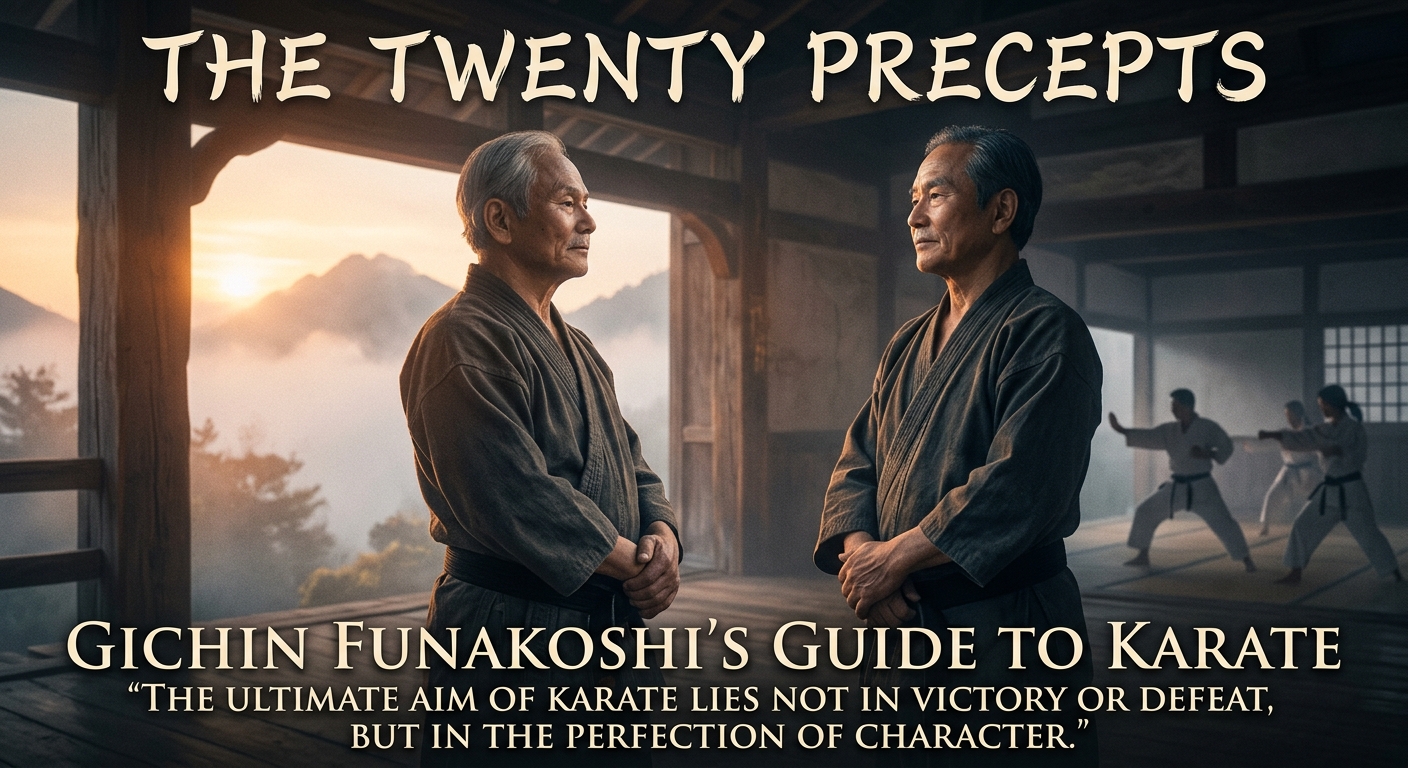
When Gichin Funakoshi (1868–1957) brought Karate from the island of Okinawa to mainland Japan in the early 1920s, he was not merely introducing a system of kicks, blocks, and strikes. He was offering a way of life—a Do (path) rooted in character, restraint, and mental discipline.
To ensure that the physical power taught in the dojo was guided by a strong moral framework, Funakoshi compiled the Nijū Kun (Twenty Precepts). These principles form the philosophical backbone of modern Shotokan Karate and serve as practical maxims for daily living.
The Philosophy Behind the Precepts
Funakoshi believed that a martial art stripped of morality becomes nothing more than violence. Drawing heavily from Zen Buddhism, Confucianism, and Bushido (the code of the samurai), he viewed the dojo as a training ground for the soul. The ultimate goal of Karate, as Funakoshi famously noted, was not victory or defeat, but the perfection of the character of its participants.
The Twenty Precepts (Nijū Kun)
While traditionally taught and memorized in Japanese, the precepts distill into clear, universal concepts:
-
Karate-do begins and ends with respect (Rei).
Etiquette and courtesy are not superficial formalities; they are expressions of humility and consideration for others.
-
There is no first strike in Karate (Karate ni sente nashi).
Karate is strictly defensive. A true martial artist never initiates violence or seeks conflict.
-
Karate stands on the side of justice.
Martial skill must only be used to defend the innocent, uphold morality, and oppose wrongfulness.
-
First know yourself, then know others.
Self-awareness and honest self-reflection must precede any attempt to evaluate or control an opponent.
-
Mentality over technique (Shin-gi-tai).
Mindset and spirit are far more critical than physical mastery. Technique without proper intent is hollow.
-
The mind must be set free.
Avoid rigidity. Keep the mind open, adaptable, and unattached so it can respond freely to any situation.
-
Calamity springs from carelessness.
Negligence, overconfidence, and loss of awareness invite injury and failure both in and out of combat.
-
Do not think Karate training is only in the dojo.
The principles learned during physical practice must be integrated into work, family, and daily interactions.
-
Karate is a lifelong pursuit.
There is no final destination in martial practice; learning is continuous and infinite.
-
Apply Karate to all things; therein lies its beauty.
When the discipline, focus, and harmony of Karate permeate everyday life, one discovers its subtle depth (Myo).
-
Karate is like boiling water.
If continuous heat is not applied, it cools. Consistent practice is required to maintain progress.
-
Do not think of winning; think rather of not losing.
Fixating on victory creates ego and recklessness. Focus instead on patience, composure, and avoiding critical mistakes.
-
Make adjustments according to your opponent.
Adaptability is essential. Victory comes from recognizing vulnerabilities and shifting strategy dynamically.
-
The outcome of a battle depends on how one handles emptiness and fullness.
Manage strengths (fullness) and weaknesses (emptiness)—both your own and your opponent's—tactically.
-
Think of hands and feet as swords.
Treat your body with seriousness and precision, knowing the gravity of the power you cultivate.
-
When you step beyond your gate, you face a million enemies.
Remain alert when entering the world. It is often an individual's own reckless behavior or lack of awareness that invites trouble.
-
Stances are for beginners; advanced practitioners use natural positions.
Formal stances build foundational strength and mechanics. Over time, techniques become natural and fluid.
-
Perform kata correctly; actual combat is another matter.
Kata (pre-arranged forms) preserves technique and ideal form, but real conflict is unpredictable and requires spontaneous adaptation.
-
Do not forget the control of power, elasticity, and speed.
Master physical dynamics: knowing when to use hard or soft power, when to expand or contract the body, and when to act quickly or slowly.
-
Be constantly mindful, diligent, and resourceful.
Continuously apply these precepts in your life, seeking new ways to cultivate personal growth every day.
Key Themes of the Nijū Kun
| Theme | Primary Focus | Precepts |
| Etiquette & Ethics | Respect, non-aggression, and justice | 1, 2, 3 |
| Mindset & Awareness | Self-control, alertness, and lifelong study | 4, 5, 6, 7, 8, 9, 10, 16, 20 |
| Combat Strategy | Adaptability, restraint, and environmental awareness | 11, 12, 13, 14, 15 |
| Physical Application | Progression from formal technique to natural movement | 17, 18, 19 |
Relevance in the Modern World
While written in early 20th-century Japan, Funakoshi's precepts transcend physical self-defense. Principles like Karate ni sente nashi (there is no first strike) apply directly to conflict de-escalation. Precepts on adaptability, continuous effort (like boiling water), and self-awareness offer timeless guidance for personal development, leadership, and emotional intelligence.
Gichin Funakoshi designed Karate not as a tool for violence, but as a framework for building character. By living these twenty precepts, a practitioner transitions from merely learning how to fight to mastering the art of living.
For a detailed breakdown of these guiding principles, Gichin Funakoshi's Twenty Guiding Principles of Karate offers a clear overview of the philosophy and its core precepts.